Practical performance advice for website owners
Optimize or Redesign Your WordPress Website? Choose the Smaller Useful Project
Need hands-on help? Request a Speed Review →
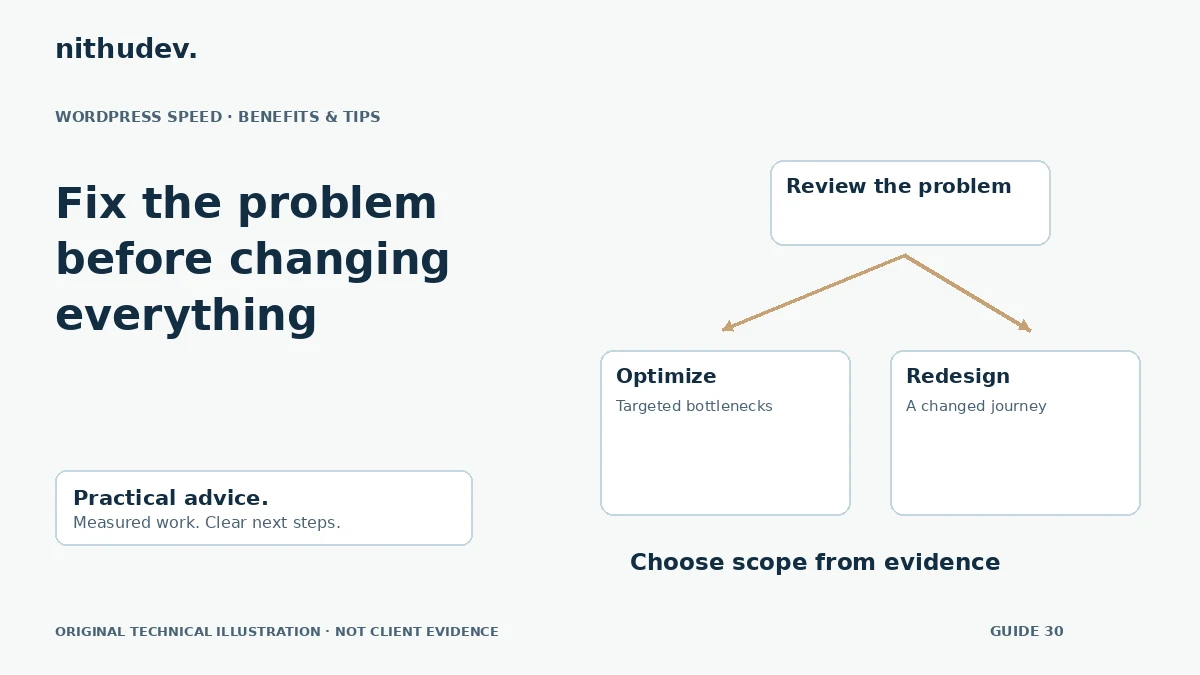
WordPress performance advice · Reviewed 3 November 2026
In this guide
Your website looks acceptable but feels slow. One quote proposes a performance package; another proposes a complete rebuild. These can solve different problems. A useful decision begins with the condition of the site and the business change you actually need.
Identify what is not working
List performance symptoms separately from design and content concerns. A late hero image, slow menu or misconfigured cache may be suitable for targeted work. Confusing navigation, outdated service information or a fundamentally different customer journey may require more than speed tuning.
Ask staff and customers to describe difficult tasks. “Make it modern” is less useful than “customers cannot find the right service or complete the request form on mobile.”
When optimization is a sensible first step
Targeted work can suit a site whose structure, branding and essential tools still meet the business’s needs. An audit may reveal a small number of expensive templates or integrations. Keeping the design can reduce disruption and make the change easier to verify.
- The current CMS remains supported and editable.
- The main features are appropriate and work reliably.
- The bottlenecks can be identified and addressed within a defined scope.
- Important content and URLs already serve useful purposes.
When a redesign or rebuild deserves consideration
A broader project may be justified by abandoned dependencies, inaccessible structure, extensive fragile custom code or a substantially changed service offer. It may also be appropriate when the team cannot maintain content without breaking layouts.
These are reasons to assess the system, not proof that every old theme must be replaced. Request evidence of the constraint and compare the cost of repairing it with the proposed rebuild.
Compare the deliverables
| Performance work | Redesign or rebuild |
|---|---|
| Agreed bottlenecks and templates | Agreed structure, design and feature changes |
| Loading and interaction improvements | New layouts, content presentation or architecture |
| Existing journey protected and retested | Old and new journeys mapped and tested |
| Measured report and handover | Migration, redirects where needed and handover |
Some projects combine both. Keep the scope clear so a small speed purchase does not become an undefined obligation to rewrite the entire website.
Protect continuity during a larger change
Preserve valuable content and URLs where practical. Plan redirects for genuine URL changes and verify forms, accounts, bookings and payment integrations. Keep a backup and a launch rollback plan.
A new design is not inherently faster. Large media, unnecessary scripts and expensive integrations can return in a fresh theme. Include performance and accessibility expectations in design review, not only in the final test.
Start with the decision you can support
When the evidence is unclear, commission a focused review rather than buying the largest proposal. Ask for likely causes, safe fixes, risks, exclusions and a recommendation. The goal is the smallest appropriate project that makes the website more useful and maintainable.
No option guarantees a specific score, search ranking or increase in sales. Compare the proposed work and testing, then approve the scope before implementation.
Work directly with Nithu
Get help with your WordPress performance
If you are deciding between optimization and redesign, I can review the existing site and explain which problems fit each kind of project.
Request a Speed ReviewCompare the $79, $179 and $349 one-time packages →
No payment is needed for an enquiry. Scope is confirmed before work; paid tools, hosting and out-of-scope development are separate unless agreed. No fixed score or ranking guarantee.
Technical references
Written for website owners planning performance work. Technical options depend on the installed versions, hosting and integrations. Test changes safely and retain a recovery path. The featured diagram is an original editorial illustration, not a measured result or customer case study.