Practical performance advice for website owners
WordPress Landing Page Speed for Paid Traffic: Help Visitors Reach the Offer
Need hands-on help? Request a Speed Review →
WordPress performance advice · Reviewed 3 November 2026
In this guide
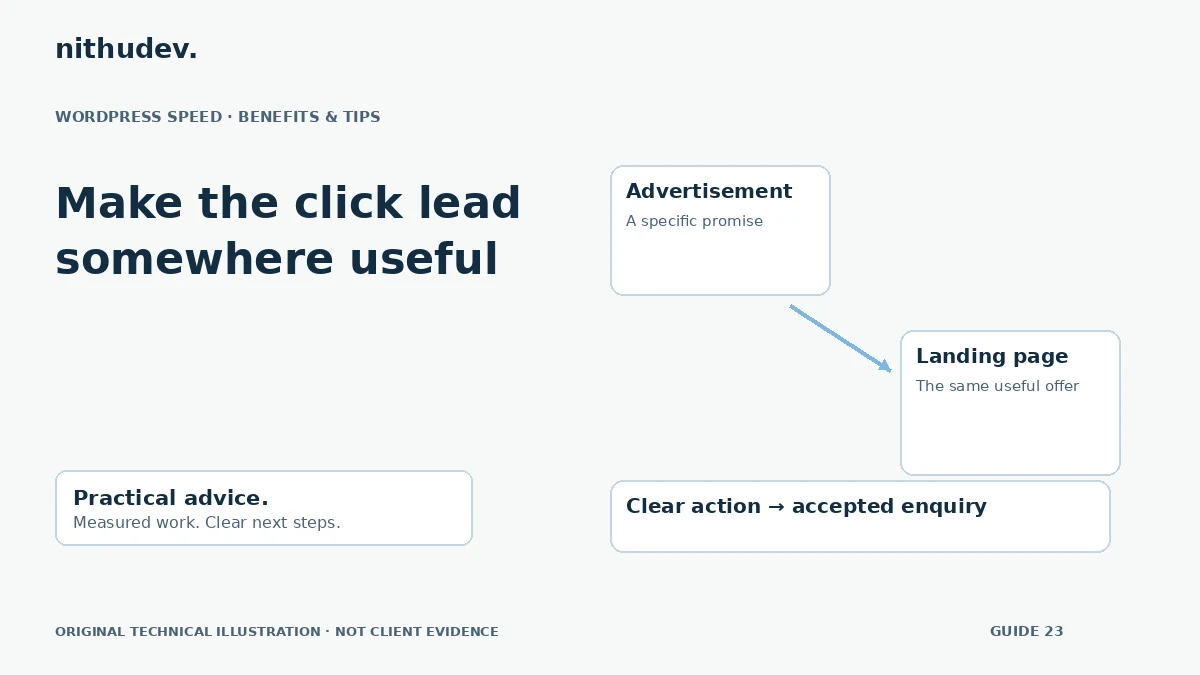
Someone clicks an advertisement because it promises help with a specific problem. The landing page should quickly confirm that they are in the right place. If the offer hides behind a heavy introduction or an unresponsive form, the visitor must work harder before they can enquire.
This applies to search, social and AI-assisted advertising traffic. The platform does not remove the need for truthful copy, useful performance and a dependable next step.
Match the first screen to the advertisement
Use a descriptive headline and explain the actual service. If the ad discusses a speed review, show how to request one and whether payment is required. Do not turn a free-review message into an unexpected purchase requirement.
Keep the primary action understandable before decorative video, review widgets or optional chat has finished loading. A visible starting price can help qualify enquiries when it accurately reflects the available service and its limits.
Audit the campaign URL, not just the clean page
Visit the actual destination with its legitimate campaign parameters. Confirm that redirects retain the intended page and attribution, without loops or unnecessary intermediate pages. Cache behaviour may differ from the URL tested in a generic audit.
Do not strip all query parameters blindly. Some carry measurement information; others control a legitimate purchase flow. Classify them before changing caching or redirects, and keep order prices under server control.
Protect the conversion interaction
On a phone, tap the main CTA while the page is loading. Check anchor positioning, keyboard focus and the first form field. A visitor should not need a second tap because delayed JavaScript initialized after the first one.
- Keep the form limited to the information needed for a useful response.
- Retain server-side validation and anti-spam protection.
- Show a pending state without claiming premature success.
- Keep the entered information when a recoverable error occurs.
Review marketing scripts with the campaign owner
Identify duplicate tags, obsolete integrations and tools that do not need to run on this page. Evaluate their cost in a controlled comparison, then agree any changes. Removing all analytics to improve a score would make campaign evaluation less reliable.
Respect the existing consent configuration. Delaying a tag until interaction can change what is measured, so verify page views and lead events rather than assuming the reports stay equivalent.
Use an honest measurement plan
Record page visits, successful submissions, qualified enquiries and verified purchases as separate stages. A package click indicates interest; it is not a sale. Do not send email addresses, issue descriptions or credentials in general analytics events.
Compare like-for-like campaigns where possible, noting changes to targeting, creative, spend and pricing. A faster page may remove friction, but a weak offer or poorly matched audience can still perform badly. No technical change alone guarantees a return on advertising spend.
What to ask a developer to deliver
Request comparable device tests, a list of changes, mobile interaction checks and a verified submission path. For paid checkout, use an authorised sandbox for approval and payment-status verification. Report any unavailable test stage instead of making an unauthorised live charge.
Work directly with Nithu
Get help with your WordPress performance
Send the landing-page URL and intended conversion action. I can investigate the loading and enquiry path without replacing your existing tracking or checkout.
Request a Speed ReviewCompare the $79, $179 and $349 one-time packages →
No payment is needed for an enquiry. Scope is confirmed before work; paid tools, hosting and out-of-scope development are separate unless agreed. No fixed score or ranking guarantee.
Technical references
Written for website owners planning performance work. Technical options depend on the installed versions, hosting and integrations. Test changes safely and retain a recovery path. The featured diagram is an original editorial illustration, not a measured result or customer case study.