Practical performance advice for website owners
WordPress Redirect Chains: Remove Unnecessary Hops Without Losing Useful URLs
Need hands-on help? Request a Speed Review →
WordPress performance advice · Reviewed 3 November 2026
In this guide
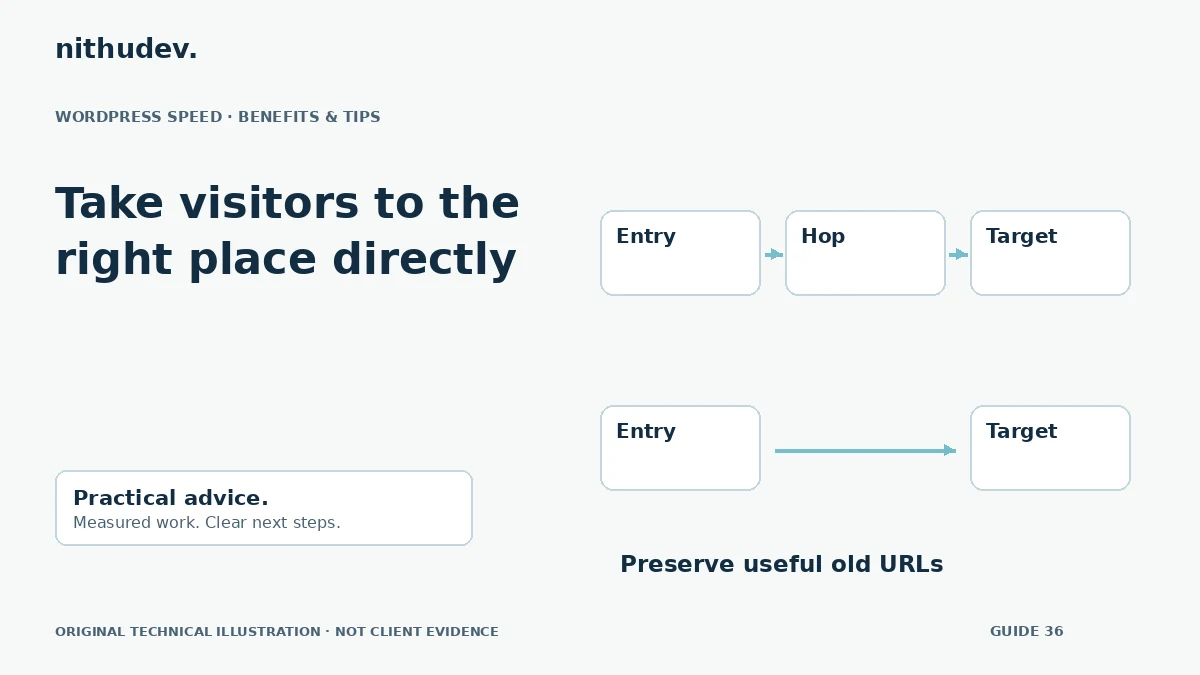
A visitor opens a link, waits through several redirects and finally reaches the service page. The destination may be correct, but the route can add unnecessary work. Fixing that route requires care because redirects also preserve useful old URLs and enforce security or canonical choices.
Follow the exact entry URL
Test the address customers actually use, including its scheme, hostname, path and legitimate query parameters. Record every response status and destination. A clean canonical URL may behave differently from an old advertisement, social link or bookmarked page.
Use browser network tools or an appropriate HTTP client to inspect the chain. Distinguish a server redirect from a script-driven navigation. Keep the observation date because CDN and host rules can change.
Identify the owner of each hop
A chain can involve the CDN, hosting configuration, WordPress canonical behaviour, an SEO plugin or a custom service selector. Changing one layer without understanding the others can create loops or unexpected destinations.
For example, a domain change, HTTPS enforcement and trailing-slash correction may be configured in several places. Agree the intended canonical address before consolidating the route.
Keep redirects that serve a real purpose
An old service URL with useful links may need a permanent redirect to the relevant replacement. Do not remove it merely because a report lists a redirect. Update internal links to the final destination where appropriate, while keeping the old entry route functional.
- Preserve meaningful old content relationships.
- Keep secure scheme and preferred-host behaviour.
- Retain required login, session and checkout transitions.
- Handle campaign parameters deliberately.
A package-selection redirect can create a native cart before checkout. It is not equivalent to an unnecessary marketing hop. Never replace that flow with a cached shortcut that skips the required session work.
Make a small, reversible change
Back up the relevant rules and record which system controls them. Test the intended consolidation on staging or a controlled route first. Avoid broad patterns that accidentally catch assets, administration, APIs or payment callbacks.
If the website has moved, match old URLs to relevant destinations rather than sending everything to the homepage. Keep content and SEO decisions separate from performance shortcuts.
Check the complete destination
Confirm the final response status, canonical, indexing directives and important content. Then test the customer’s next action: contact, booking or cart selection. Verify that legitimate parameters still reach the intended handler and that private or session-specific responses are not shared-cached.
For form submissions and other non-GET operations, redirect semantics can affect method handling. Use supported application behaviour and technical review rather than copying a generic rule.
Report the change accurately
Show the original and revised routes, the reason for each retained redirect and the tests performed. Reducing hops may improve the entry path, but it does not fix an expensive page after arrival or guarantee a ranking change.
A focused redirect review is useful when campaigns, migrations or canonical rules have accumulated over time.
Work directly with Nithu
Get help with your WordPress performance
Share the entry URL customers use, not only the final page. I can trace the route and identify unnecessary hops while preserving legitimate flows.
Request a Speed ReviewCompare the $79, $179 and $349 one-time packages →
No payment is needed for an enquiry. Scope is confirmed before work; paid tools, hosting and out-of-scope development are separate unless agreed. No fixed score or ranking guarantee.
Technical references
Written for website owners planning performance work. Technical options depend on the installed versions, hosting and integrations. Test changes safely and retain a recovery path. The featured diagram is an original editorial illustration, not a measured result or customer case study.