Practical performance advice for website owners
WordPress Resource Hints: When Preconnect, DNS Prefetch and Preload Help
Need hands-on help? Request a Speed Review →
WordPress performance advice · Reviewed 3 November 2026
In this guide
A speed guide suggests preconnecting to several domains and preloading a collection of files. That advice only helps when those resources are important, actually used and otherwise discovered too late. A hint is a request to prioritise work, so it needs a reason.
Start from the request timing
Inspect the resource waterfall and identify the delay. Does the browser wait to discover a necessary asset, spend time connecting to an important external origin or simply download a file that is too large? Different causes need different changes.
Check the real page and device layout. The desktop background or a font weight may not be used on mobile. Avoid prioritising a resource merely because it appears in a theme settings screen.
Distinguish the hints
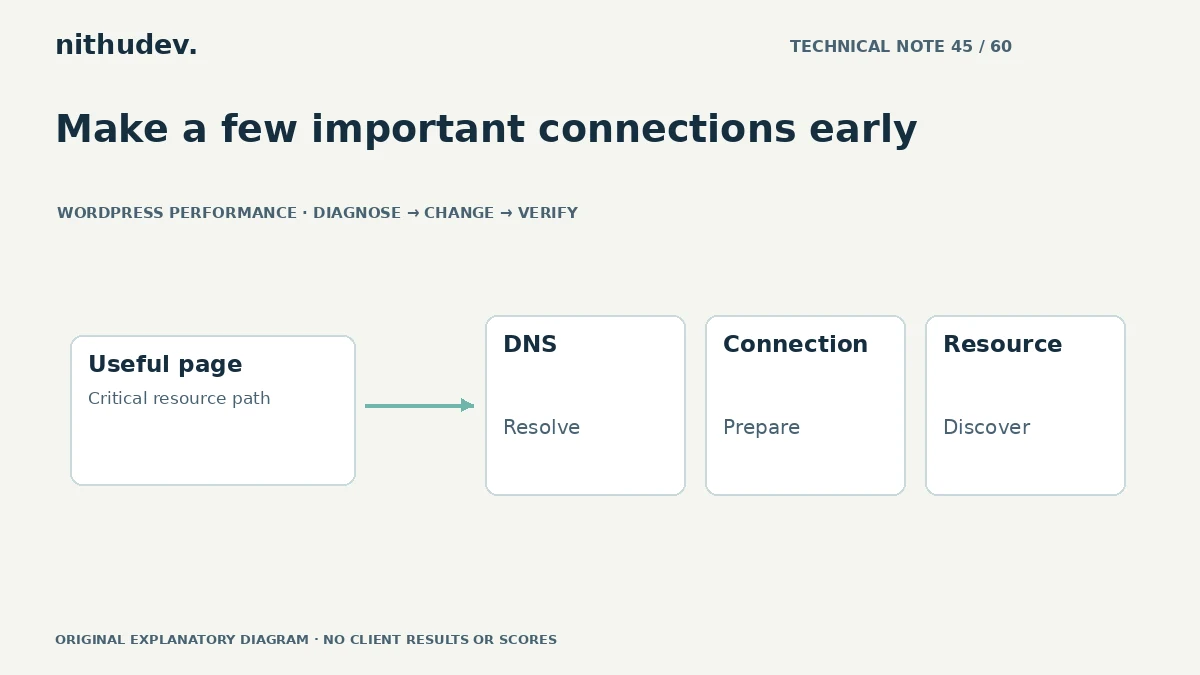
DNS prefetch prepares name resolution. Preconnect goes further toward establishing a connection to an origin. Preload identifies a specific resource to fetch early for the current page. These are different from preparing an entire possible next navigation.
Use current platform guidance for the relevant resource type, including cross-origin requirements where applicable. A hint pointing to the wrong file can add work rather than removing a delay.
Choose a small set of justified candidates
- An essential external origin discovered late in the loading path.
- A genuinely critical font used in the initial content.
- An important image whose discovery cannot be improved more directly.
First consider whether the underlying markup can make the resource discoverable normally. A readable image element can be preferable to an elaborate background-loader workaround. Do not mark every gallery image as urgent.
Check responsive resources and duplication
If an image has several candidates, verify which one the browser chooses for the viewport and pixel density. An unconditional preload of a different candidate may produce another download. Test the final HTML after the performance plugin rewrites it.
Fonts and scripts can also be requested with attributes that must match their later use. Watch the network and console rather than assuming that a hint printed in the head is effective.
Respect consent and optional services
An early connection to a third-party service can have privacy implications even before its full widget loads. Keep hints consistent with the site’s agreed consent behaviour. A chat or advertising origin is not automatically essential to showing the offer.
Do not add a new tracking or payment service as part of resource-hint work. Review the integrations already approved and preserve their supported configuration.
Compare and remove ineffective hints
Run several comparable tests with the same visitor conditions. Record whether the intended resource starts or renders earlier and whether other important work is delayed. Remove obsolete hints when templates or fonts change.
The result should be a short documented set of decisions, not a growing list copied from unrelated websites. Hints complement a sound page; they cannot guarantee a score or fix every server bottleneck.
Work directly with Nithu
Get help with your WordPress performance
I can inspect the critical requests and determine whether a loading hint, clearer markup or a different optimization is the useful next step.
Request a Speed ReviewCompare the $79, $179 and $349 one-time packages →
No payment is needed for an enquiry. Scope is confirmed before work; paid tools, hosting and out-of-scope development are separate unless agreed. No fixed score or ranking guarantee.
Technical references
Written for website owners planning performance work. Technical options depend on the installed versions, hosting and integrations. Test changes safely and retain a recovery path. The featured diagram is an original editorial illustration, not a measured result or customer case study.