Practical performance advice for website owners
Cloudflare for WordPress Speed: What a CDN Helps—and What Still Needs Work
Need hands-on help? Request a Speed Review →
WordPress performance advice · Reviewed 3 November 2026
In this guide
Connecting a WordPress website to a CDN can be useful, especially when visitors are far from the origin server. It is not a complete performance project. The browser may still download oversized media, execute expensive scripts or wait for dynamic work that cannot be shared between customers.
Distinguish static delivery from HTML caching
Images, stylesheets and scripts are different from the HTML document generated by WordPress. Cloudflare’s Automatic Platform Optimization is designed to extend delivery to eligible WordPress HTML. Do not assume that an ordinary proxied DNS record automatically gives every page the same caching behaviour.
Confirm which Cloudflare products and rules are actually active for the site. Read the response headers for the document as well as its assets. An edge hit on a logo does not prove the page itself bypassed origin processing.
Identify the bottleneck before adding rules
Compare relevant visitor locations and cache states. If distance to the origin contributes to repeatable document or asset delays, an appropriate edge configuration may help. If the slowdown occurs while a local browser executes a widget, caching that widget’s file nearer the visitor may not resolve its runtime cost.
Likewise, a slow shipping or booking API still needs investigation. The CDN cannot safely return another visitor’s personalised response simply because it would be quicker.
Map the routes that must stay dynamic
- WordPress login, administration and preview routes.
- WooCommerce cart, checkout and account experiences.
- Session-dependent booking, forms and security challenges.
- Payment callbacks, webhooks and relevant API requests.
- Responses containing private customer information.
Check current platform guidance and the behaviour of your specific integration. Avoid broad rules that ignore cookies or cache every query string. If the site has a custom package selector, it must create the correct native cart/session rather than being replaced by an old cached redirect.
Plan content updates and purging
Publish a harmless content change on a test route and verify when it appears publicly. Check the origin cache and edge cache separately. If multiple systems process the same asset, document the order and purge requirements.
After changing image formats or asset URLs, confirm that the intended resource loads and that existing links remain valid where required. A new page should not keep showing an old design or price because one layer was missed.
Test security controls alongside performance
A firewall challenge can protect an exposed route but also interrupt a legitimate form request or third-party callback if applied incorrectly. Review actual responses and platform logs rather than disabling protection globally. Scope adjustments to the verified requirement.
Test two clean visitor sessions, logged-in access, the quote form and the complete checkout journey in an authorised environment. Verify that no personal data appears in a shared response. Keep account credentials and API tokens in supported secure configuration, not page code.
When a CDN is not the first purchase
If the main problem is a large hero video, duplicate scripts or a broken cache plugin configuration, fix that first. A CDN can complement a sound application; it should not obscure the diagnosis. For a small local service site, a simpler hosting and asset setup may be the most appropriate starting scope.
Work directly with Nithu
Get help with your WordPress performance
If you already use Cloudflare, I can review the existing rules and cache behaviour before recommending another subscription or a risky blanket rule.
Request a Speed ReviewCompare the $79, $179 and $349 one-time packages →
No payment is needed for an enquiry. Scope is confirmed before work; paid tools, hosting and out-of-scope development are separate unless agreed. No fixed score or ranking guarantee.
Technical references
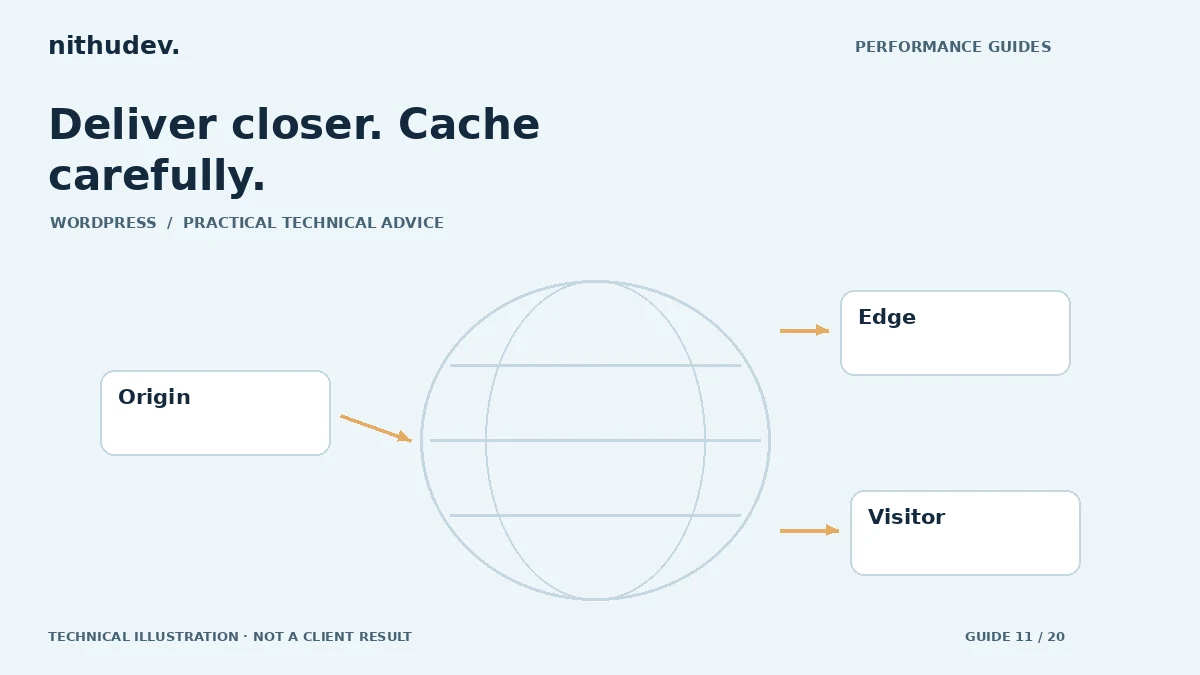
Written for website owners planning performance work. Technical options depend on the installed versions, hosting and integrations. Test changes safely and retain a recovery path. The featured diagram is an original editorial illustration, not a measured result or customer case study.