Practical performance advice for website owners
Long WordPress Pages: When Content Visibility Can Help Rendering
Need hands-on help? Request a Speed Review →
WordPress performance advice · Reviewed 3 November 2026
In this guide
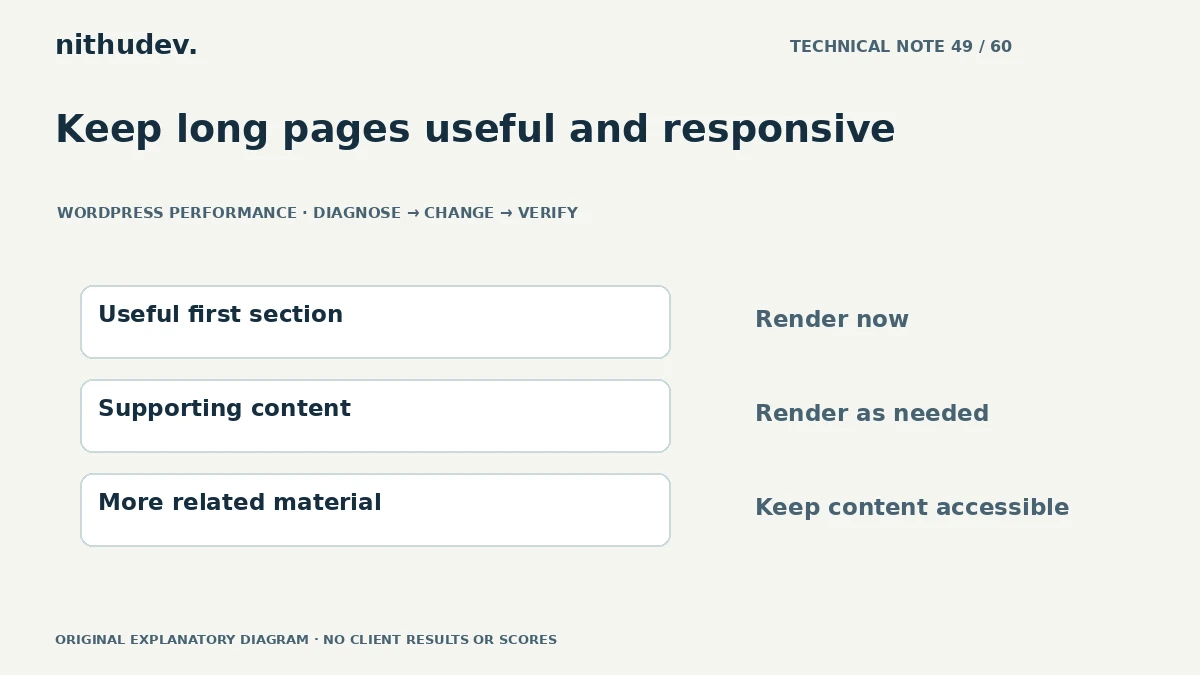
A long guide or service page can contain many cards and supporting sections. The browser must manage their layout even when the visitor is looking near the top. Advanced rendering controls may help some pages, but they need evidence and testing.
Identify the rendering cost first
Record a performance trace while loading, scrolling and opening relevant controls. Look for expensive style or layout work. A long page that spends most of its time waiting for the server needs a different first investigation.
Check the number of components and whether they all belong on one page. Useful headings, native disclosures or appropriate pagination may be simpler than a new rendering technique.
Understand what content visibility changes
The CSS content-visibility property can let the browser skip certain rendering work for content outside the relevant view. It does not automatically stop images, scripts or other resources from downloading. Loading strategy remains a separate responsibility.
Use the behaviour appropriate to the component, rather than treating it as an interchangeable substitute for hidden content. Review current browser support and accessibility guidance.
Reserve realistic space
Containment and intrinsic-size settings can affect how much space is estimated before content is rendered. Poor assumptions can cause movement as the visitor scrolls. A section with a variable number of cards needs particular care.
- Test short and long real content.
- Check mobile text wrapping and enlarged text.
- Watch for jumps near deferred sections.
- Verify that scrolling to an anchor lands usefully.
A copied fixed placeholder height is unlikely to fit every template and language. Keep the configuration tied to the actual layout.
Preserve content discovery and interaction
Check find-in-page, keyboard focus, screen-reader behaviour where available and links to section IDs. Essential information should remain available through the page’s supported structure. Do not use rendering controls to hide content from visitors while leaving it only for search engines.
Nested components with their own visibility logic deserve review. An offscreen menu, dialog or hidden panel must retain its intended semantics when the browser postpones rendering decisions.
Keep ordinary loading improvements in place
Use appropriately sized media, lazy loading where suitable and a restrained script stack. Content visibility cannot repair a gallery that downloads every full-size image at startup or a global third-party script that blocks interactions.
If many result cards are unnecessary to the initial task, a bounded page or useful expansion may be the more maintainable choice.
Adopt only a measured improvement
Compare the same scrolling and interaction tasks with and without the change. Verify layout stability and the fallback in unsupported conditions. Remove the technique if its complexity or regressions outweigh the observed benefit.
This is a targeted engineering option for suitable layouts, not a universal WordPress speed switch or a guaranteed score improvement.
Work directly with Nithu
Get help with your WordPress performance
If a long page becomes sluggish while scrolling or expanding content, I can investigate rendering work and recommend the simplest appropriate layout or containment change.
Request a Speed ReviewCompare the $79, $179 and $349 one-time packages →
No payment is needed for an enquiry. Scope is confirmed before work; paid tools, hosting and out-of-scope development are separate unless agreed. No fixed score or ranking guarantee.
Technical references
Written for website owners planning performance work. Technical options depend on the installed versions, hosting and integrations. Test changes safely and retain a recovery path. The featured diagram is an original editorial illustration, not a measured result or customer case study.