Practical performance advice for website owners
WordPress Cron and Scheduled Actions: Investigate Background Slowdowns Safely
Need hands-on help? Request a Speed Review →
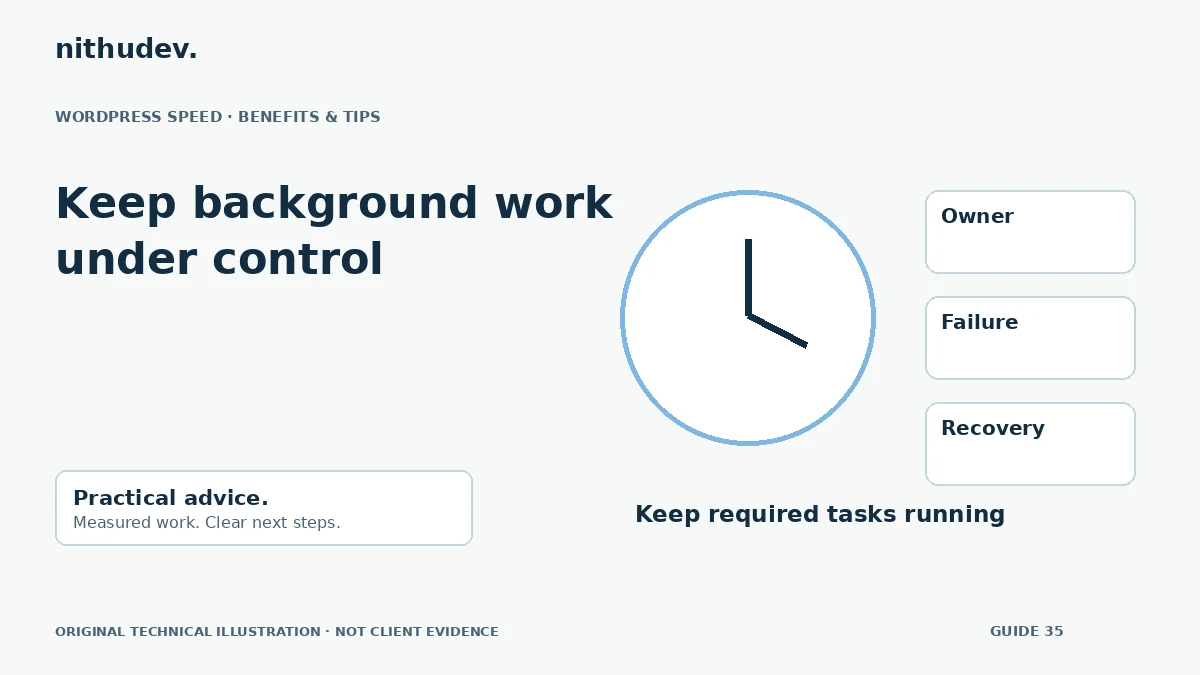
WordPress performance advice · Reviewed 3 November 2026
In this guide
Your website slows at similar times each day, or the admin reports many pending actions. Backups, imports, notifications and integration jobs may be involved. The goal is to understand their workload and reliability, not to remove every background process.
Know which scheduler owns the work
WordPress uses WP-Cron for scheduled tasks. WooCommerce and extensions can also use the Action Scheduler system. Hosting may provide a system-level trigger. Document the actual setup before changing it.
WP-Cron is not a continuously running server clock. If a different trigger is proposed, it must be configured and verified before the existing mechanism is disabled. Otherwise scheduled publishing or maintenance can stop.
Match timing evidence to the slowdown
Record the slow URLs, timestamps and timezone. Compare them with backup activity, imports, exports and scheduled-action logs. A coincidence is a lead for investigation, not proof that the job caused the delay.
Review hosting resource information and request timings where available. If the browser is busy executing a heavy widget, a server schedule may not explain the problem.
Investigate repeated failures
Look for an unavailable external API, expired supported connection, invalid data or a recurring application error. A retry queue can grow because its underlying dependency is still broken. Running the queue more aggressively may increase pressure without completing useful work.
Keep logs private and redact customer or credential information from reports. Determine which plugin or workflow owns each action and consult its supported recovery procedure.
Avoid destructive shortcuts
- Do not delete all pending actions to make a dashboard look clean.
- Do not disable required notification or subscription processing.
- Do not run heavy batches repeatedly on production without an agreed plan.
- Do not assume an unfamiliar hook is malicious or unnecessary.
If security concerns arise, handle them as an incident investigation rather than ordinary performance cleanup. Scheduling performance and malicious persistence are different questions, even when the same diagnostic screens are involved.
Plan workload and recovery
Where supported, schedule heavy maintenance during an appropriate window and use manageable batch sizes. Coordinate concurrency and hosting limits with the provider. Back up relevant data before corrective changes and define how interrupted work will be recovered.
A custom integration should avoid duplicate business actions when retried. Confirm actual completion and maintain a useful record of failures. Do not describe an acknowledged HTTP request as proof that a downstream task finished.
Verify the operational outcome
Check that the expected jobs execute, required records update and notifications follow the agreed test process. Repeat the affected visitor or staff task during representative workload. Report remaining provider limits and anything not tested.
Recurring queue management and monitoring are ongoing responsibilities. A one-time speed package should not imply unlimited background-system support or a rewrite of every integration.
Work directly with Nithu
Get help with your WordPress performance
If repeated scheduled jobs coincide with slowdowns, I can review their ownership, failures and resource impact before recommending changes.
Request a Speed ReviewCompare the $79, $179 and $349 one-time packages →
No payment is needed for an enquiry. Scope is confirmed before work; paid tools, hosting and out-of-scope development are separate unless agreed. No fixed score or ranking guarantee.
Technical references
Written for website owners planning performance work. Technical options depend on the installed versions, hosting and integrations. Test changes safely and retain a recovery path. The featured diagram is an original editorial illustration, not a measured result or customer case study.